Thailand LTR Visa Categories 2026: Which One You Qualify For
The most common LTR Visa mistake is not in the application. It is choosing the wrong category before the application starts. Each of the four categories has different income thresholds, different asset requirements, and different rules for what counts as qualifying income. Applying under the wrong one costs you months.
The good news is the categories are cleaner than they look. Once you understand the logic of each, the right one is usually obvious within five minutes.
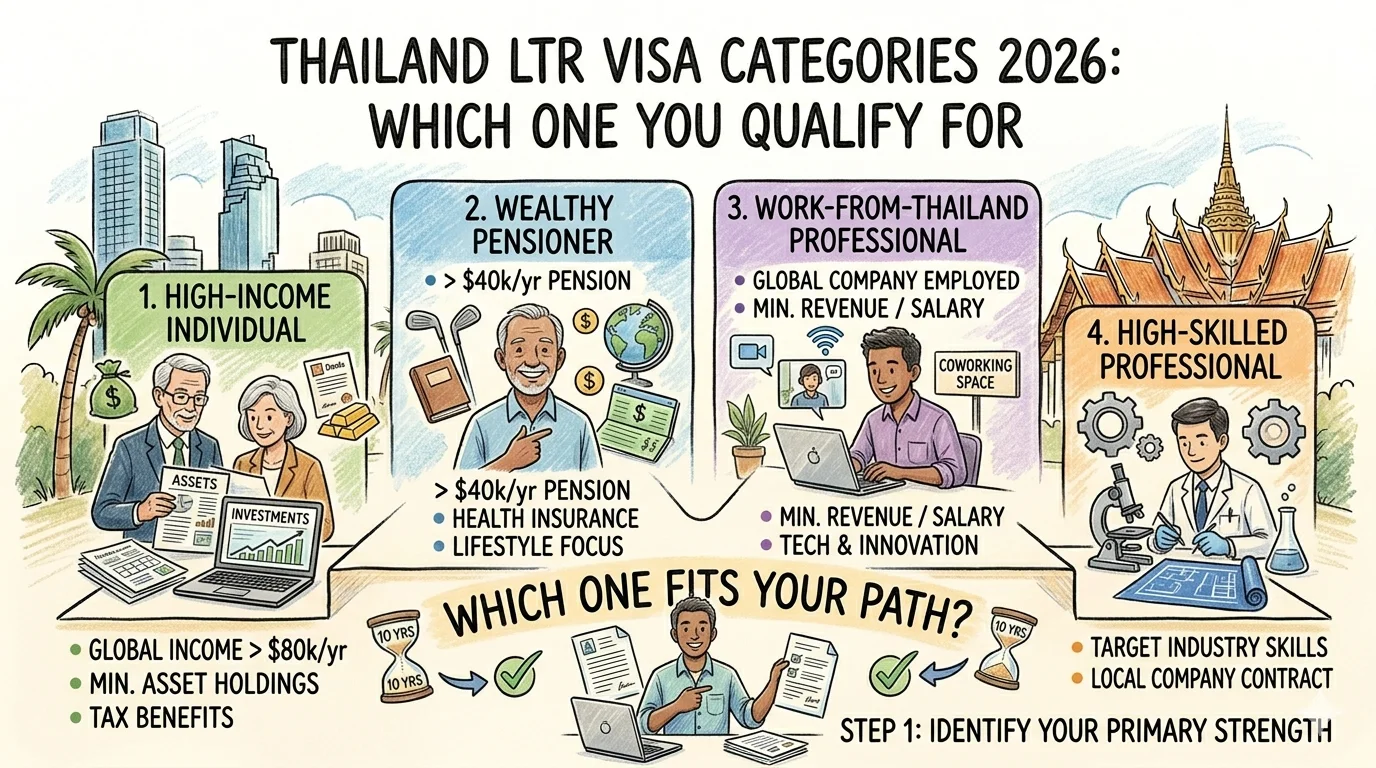
The Four Categories at a Glance
Category | Who It Is For | Income Requirement | Investment Required |
|---|---|---|---|
Wealthy Global Citizen | High-net-worth individuals | No income threshold | USD 1M in assets, USD 500K invested in Thailand |
Wealthy Pensioner | Retirees 50+ | USD 80K passive income | USD 250K in Thailand if income USD 40K–80K |
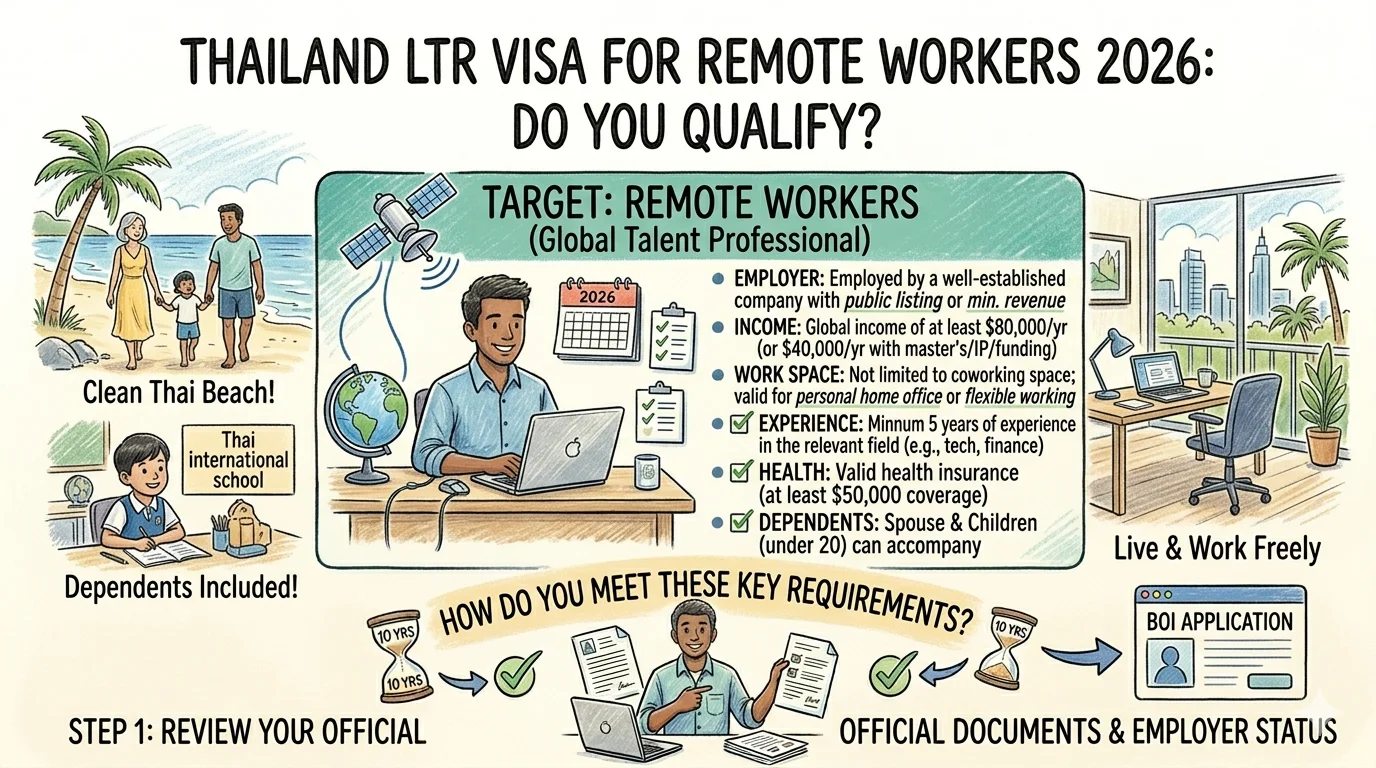
Work-from-Thailand Professional | Remote workers employed abroad | USD 80K employed income | None |
Highly Skilled Professional | Experts in targeted industries in Thailand | USD 80K Thai-sourced income | None |
All categories require health insurance with minimum USD 50,000 coverage, or alternatively USD 100,000 maintained in a Thai bank account for at least 12 months, or current social security coverage in Thailand.
Every condition must be maintained throughout the full visa duration. If your income drops below the threshold, your investment is liquidated, or your insurance lapses, your LTR status is at risk.
Full official criteria: ltr.boi.go.th
Category 1: Wealthy Global Citizen
Best for: High-net-worth individuals who want Thai residency backed by existing assets rather than employment income.
This category has no personal income threshold. It is built around asset ownership and investment in Thailand. To qualify you need two things simultaneously:
1. Global assets of at least USD 1 million in your name. This can include or combine with the Thai investment below.
2. Investment in Thailand of at least USD 500,000 in your name, in one or a combination of:
Thai Government Bonds with a remaining maturity of at least 5 years
Direct investment in companies registered in Thailand
Investment in Thai property
The investment must already be in place before you apply. The BOI does not accept conditional or planned investments. If the property or bonds are jointly owned, only your proportional share counts toward the USD 500,000 threshold.
Tax benefit: 0% personal income tax on foreign-sourced income remitted to Thailand.
The honest constraint: Liquidating existing investments to meet the USD 500,000 Thailand requirement affects your global USD 1 million threshold calculation. Structure carefully before applying rather than discovering the shortfall mid-process.
Category 2: Wealthy Pensioner
Best for: Retirees aged 50 and older with pension income, rental income, dividends, or other passive income streams.
This is the retiree category. The income that counts is specifically unearned or passive income. Earned income and salaries are explicitly excluded. The BOI defines qualifying passive income as pension payments, rental income, realised capital gains, dividends, and interest payments.
Standard route: Passive income of USD 80,000 or more per year at the time of application. No investment in Thailand required.
Reduced income route: If your passive income is between USD 40,000 and USD 80,000 per year, you must make an additional investment of USD 250,000 in Thailand in one or a combination of:
Thai Government Bonds with remaining maturity of at least 5 years
Direct investment in companies registered in Thailand
Investment in Thai property
The investment must already be completed before you apply.
Tax benefit: 0% personal income tax on foreign-sourced income remitted to Thailand.
The honest constraint: Social security payments from your home government count as passive income for this category. Private pension payments count. Salary from part-time or consulting work does not. If your income is a mix of passive and earned, only the passive portion is counted toward the USD 80,000 threshold.
Category 3: Work-from-Thailand Professional
Best for: Remote workers employed by overseas companies who want to base themselves in Thailand long-term.
This category was designed for the global remote work market. You work for a foreign employer, you live in Thailand, and the LTR gives you legal residency and a digital work permit to do it properly.
Income requirement: Average personal income of USD 80,000 per year over the past two years. If your income is between USD 40,000 and USD 80,000, you must provide proof of a master's degree or higher as an additional qualification.
Employer requirement: This is where most applicants hit difficulty. Your employer must be one of the following:
A public company listed on a recognised stock exchange
A private company with at least 3 years of operation and combined revenue of USD 50 million or more over the last 3 years
A wholly owned subsidiary of either of the above
Freelancers, self-employed individuals, and employees of small private companies that do not meet the revenue threshold do not qualify under this category in its standard form. For how this plays out in practice and what options exist for independent workers, see Thailand LTR Visa for Remote Workers 2026.
Tax benefit: 0% personal income tax on foreign-sourced income remitted to Thailand.
Work permit: A digital work permit is available through the BOI portal for this category, allowing you to work legally in Thailand without a separate work permit application process.
Category 4: Highly Skilled Professional
Best for: Specialists, experts, and senior professionals working within Thailand in BOI-targeted industries.
This is the only category where your employer is a Thai company or institution and you are working physically in Thailand. The others are for people living in Thailand with income or assets from elsewhere. This one is for people whose job is here.
Income requirement: Average personal income of USD 80,000 per year over the past two years. If your income is between USD 40,000 and USD 80,000, you must provide a master's degree or higher in sciences and technology as an additional qualification. Applicants working for Thai government agencies are exempt from the income requirement entirely.
Industry requirement: You must be employed by contract in a Thai or foreign company operating in one of the BOI's targeted industries, or provide proof of recognised expertise in a BOI-specified field.
The targeted industries are: automotive, electronics, affluent tourism, agricultural and biotechnology, transportation and logistics, automation and robotics, aviation, biofuels and biochemicals, digital, medical, defence, petrochemical and chemical, international business centres, and industries facilitating the circular economy.
Full targeted industry list: ltr.boi.go.th/page/targeted-industries.html
Tax benefit: A flat 17% personal income tax rate on Thai-sourced income, compared to the standard progressive rate which reaches 35% at higher income levels.
Work permit: Unlike the Work-from-Thailand category, Highly Skilled Professionals must obtain a formal work permit to perform their duties in Thailand legally.
Dependents
Spouses and children under 20 years old of any LTR visa holder are eligible for a dependent LTR visa. A maximum of 4 dependents per LTR holder applies.
Health insurance for dependents: USD 50,000 minimum coverage per dependent, or USD 25,000 maintained per dependent in a bank account for at least 12 months.
Relationship recognition:
Legal spouses qualify. Same-sex marriages are explicitly recognised under the dependent category as of current BOI rules.
Common-law partnerships and de facto relationships do not qualify. Legal registration of the relationship is required.
All supporting documents (marriage certificates, birth certificates) must be officially translated and apostilled before submission.
Required documents for dependents: ltr.boi.go.th/page/required-documents.html
Which Category Is Right for You
You have significant assets and want Thai residency without income dependency: Wealthy Global Citizen. The asset-based structure suits anyone who has built wealth outside employment.
You are retired or approaching retirement with pension or passive income: Wealthy Pensioner. Check carefully that your income is genuinely passive before applying. Consulting income, part-time salary, or active business income does not count.
You work remotely for a large overseas employer and earn above USD 80,000: Work-from-Thailand Professional. Confirm your employer meets the stock exchange listing or USD 50 million revenue threshold before starting your application.
You are a specialist working for a Thai company or institution in a qualifying industry: Highly Skilled Professional. Confirm your employer's industry is on the BOI targeted list before assuming you qualify.
Your income is USD 40,000 to USD 80,000: All four categories have a reduced-income route, but each requires either a master's degree or higher, or additional investment in Thailand. The reduced route is valid but requires more documentation.
What All Categories Have in Common
Every LTR category requires the same health insurance floor: USD 50,000 minimum coverage. This is non-negotiable across all four types. The alternative is maintaining USD 100,000 in a Thai bank account in your name for at least 12 months, or having existing social security coverage in Thailand.
Every condition that qualified you for the LTR must be maintained throughout the visa duration. Income thresholds, investment amounts, employment status, bank balances, and insurance coverage all need to remain in place. The BOI conducts annual reviews and the visa can be cancelled if conditions are no longer met.
Official Resources
All category criteria, income thresholds, and investment requirements are published and maintained by the BOI:
Full category criteria: ltr.boi.go.th
Targeted industries list: ltr.boi.go.th/page/targeted-industries.html
Required documents by category: ltr.boi.go.th/page/required-documents.html
Start your application: visa.boi.go.th/register
Immigration rules change. Verify current requirements against the official BOI portal before submitting any application.
Where to Go from Here
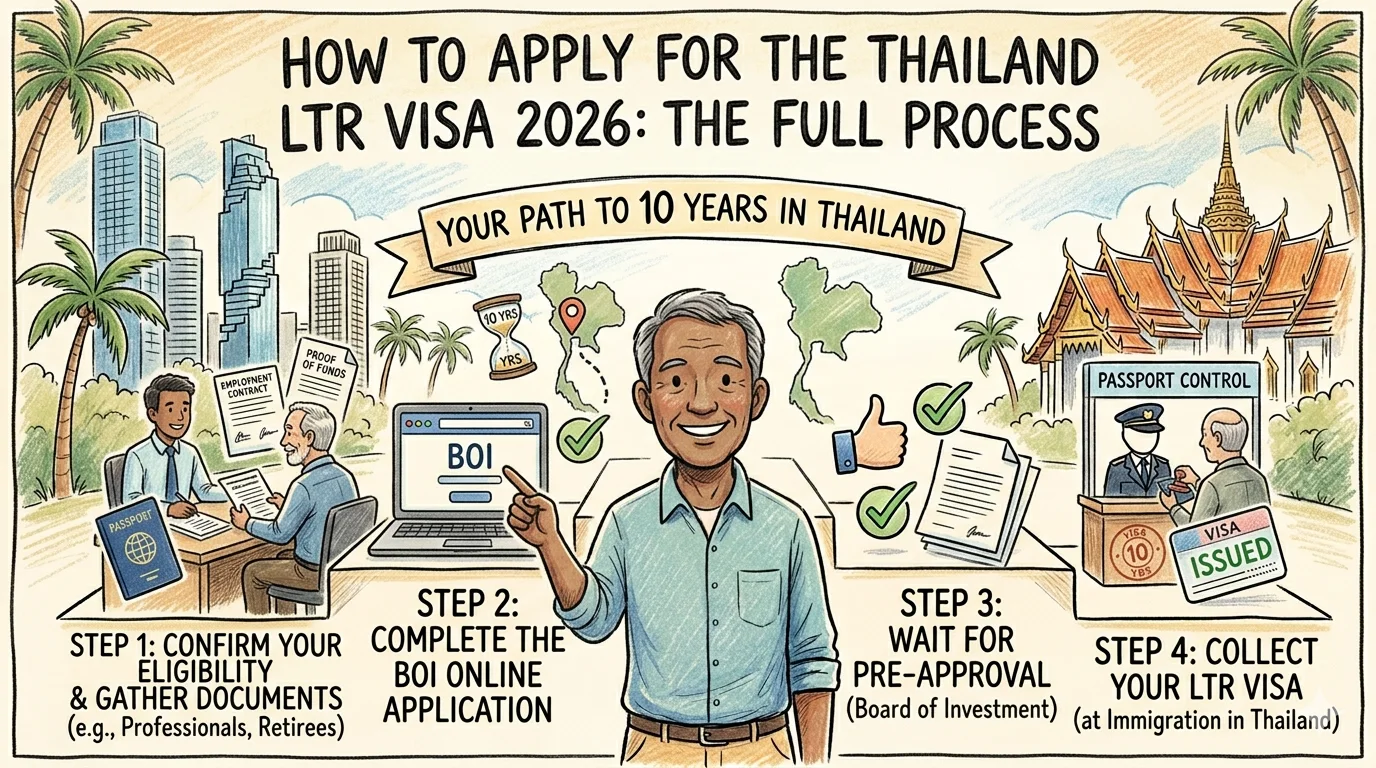
For the full step-by-step application process once you have confirmed your category: How to Apply for the Thailand LTR Visa 2026.
For remote workers assessing employer eligibility in detail: Thailand LTR Visa for Remote Workers 2026.
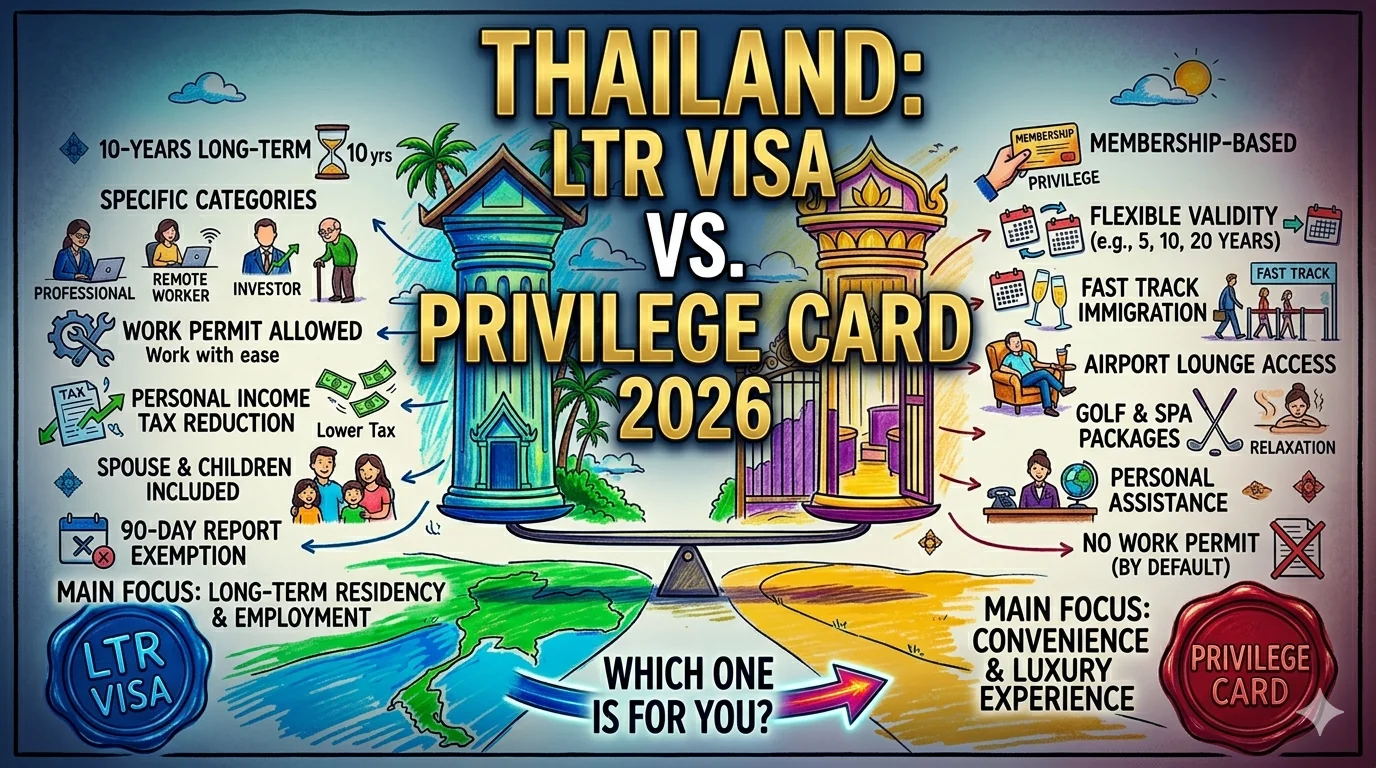
For how the LTR compares to the Thailand Privilege Card: Thailand LTR Visa vs Privilege Card 2026.
For the full LTR Visa overview: Thailand LTR Visa 2026.